By Saeed Mirshekari
January 28, 2026


Access O'Mentors
Top Data Scientist Mentors from Fortune 500 Companies excited to help you out 1-on-1!
1️⃣ Explore freely
→
2️⃣ Apply confidently
→
3️⃣ Pay securely
→
4️⃣ Book instantly
Iran’s Water Crisis Is Not About Rainfall. It Is About Per Capita Reality.
For years, the dominant explanation for Iran’s water shortages has sounded both intuitive and inevitable. Officials, state media, and even many well-intentioned observers routinely attribute the country’s worsening water crisis to declining rainfall, prolonged droughts, and the effects of climate change. This narrative has become so widely accepted that it is rarely questioned. Nature, we are told, has turned against the country.
Yet when one carefully examines the historical data, a very different story emerges — a story that is less about climate and far more about arithmetic. The numbers reveal that Iran’s rainfall has not declined in any meaningful long-term way over the past seventy years. What has changed dramatically, and almost catastrophically, is the number of people who must now share that same rainfall.
The crisis facing Iran today is not primarily a story of less rain. It is a story of far less rain per person.
This distinction may appear subtle, but it is, in fact, the key to understanding everything.
The Data That Challenges the Narrative
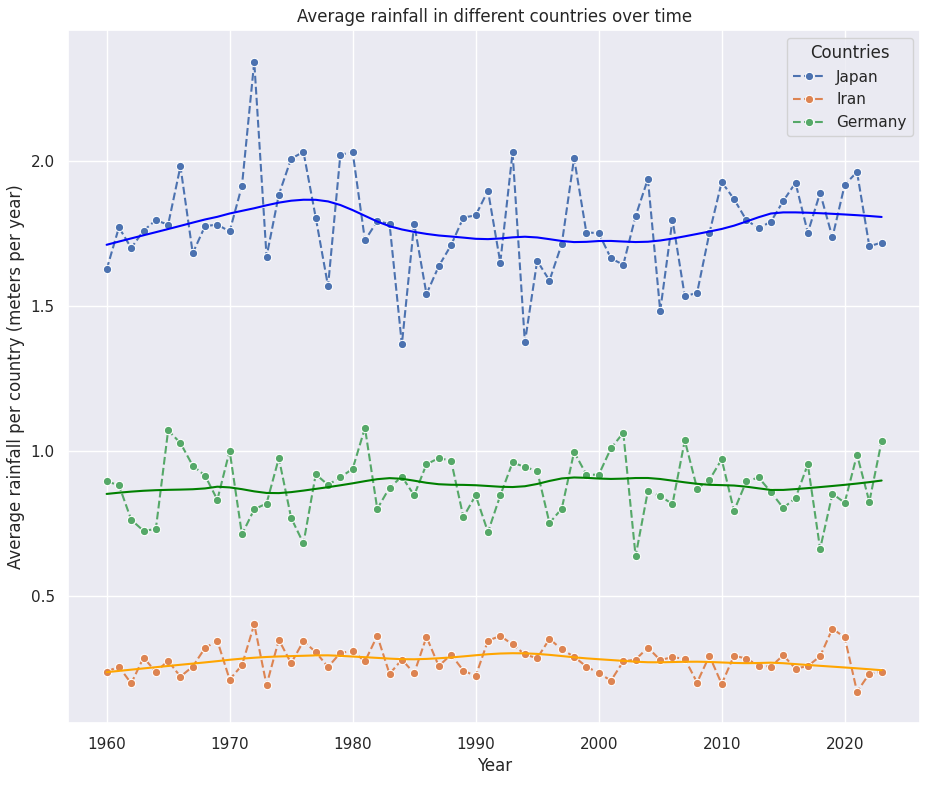
Historical precipitation records from 1960 to the present show that Iran’s average annual rainfall has remained remarkably stable over time. Like any climate record, there are fluctuations from year to year and even from decade to decade, but there is no sustained downward trend that could plausibly explain the scale of today’s water shortages.
When compared with countries such as Japan and Germany over the same period, the pattern becomes even clearer. All three countries exhibit variability in annual rainfall, but none shows a dramatic long-term decline. In fact, Iran’s trend line for total precipitation is largely flat across six decades.
If rainfall had truly been decreasing to the point of triggering a national water crisis, the data would reveal a steep and unmistakable drop. It does not.
So the obvious question becomes: if Iran is receiving roughly the same amount of rain today as it did in the 1960s, why is the country now facing severe water shortages that did not exist half a century ago?
The answer becomes visible only when we shift from looking at total rainfall to examining rainfall per capita.
When the Perspective Changes, So Does the Conclusion
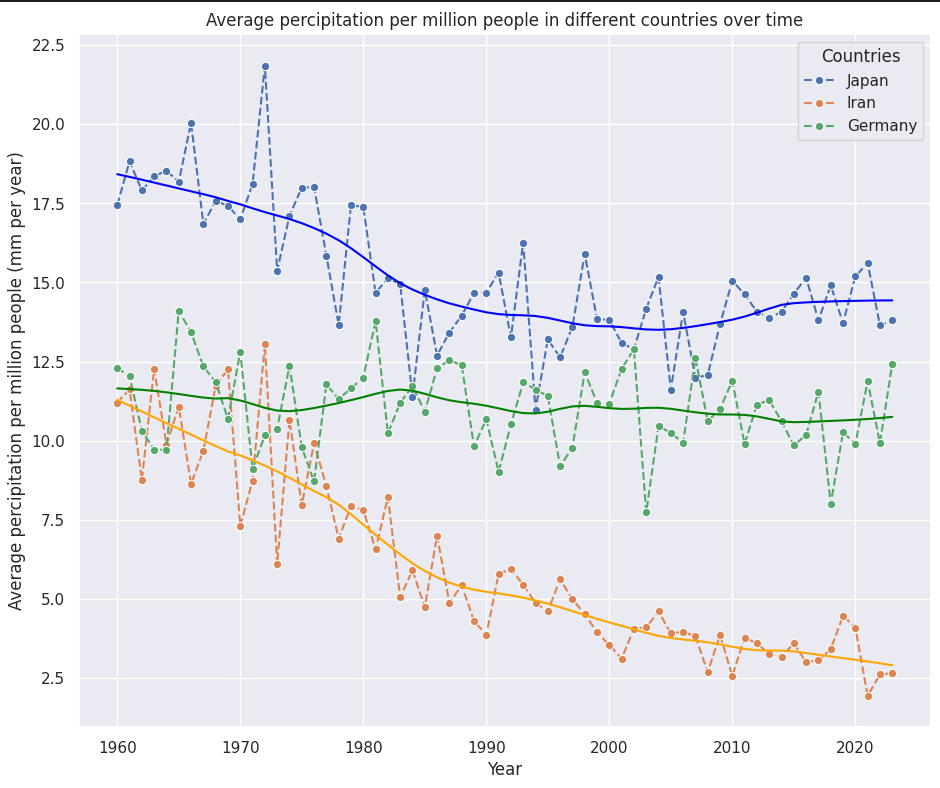
A second look at the data, this time normalized by population, transforms the entire picture. In the early 1960s, Iran and Germany had nearly identical levels of rainfall per capita. Japan, while somewhat higher, was still within a comparable range.
Today, Germany’s rainfall per capita remains almost unchanged. Japan’s has declined only slightly. Iran’s, however, has fallen by more than seventy-five percent.
This decline did not occur because the sky stopped raining. It occurred because the number of people sharing the same water resources increased nearly fourfold.
In 1960, Iran’s population was approximately 22 million. Today, it is close to 90 million. The rainfall did not quadruple to accommodate this growth. Each individual now has access to roughly one quarter of the water that was available to a citizen in the 1960s.
The implications of this fact are profound and unavoidable. Iran’s water crisis is fundamentally the result of a collapse in per-capita water availability.
Germany as a Natural Comparison
Germany offers a revealing point of comparison. It is an industrialized country with significant agricultural activity, a large population, and rainfall levels that historically matched Iran’s on a per-person basis.
Over the past six decades, Germany’s population growth has been gradual and largely aligned with its environmental capacity. As a result, its rainfall per capita has remained stable. There is no comparable national water crisis, despite similar total precipitation patterns.
The difference lies not in nature, but in planning.
Why Total Rainfall Is the Wrong Metric
Water is not consumed by a nation in the abstract. It is consumed by individuals, farms, industries, and cities. The sustainability of a country’s water supply cannot be understood by measuring total rainfall alone. The relevant measure is how much water is available to each person.
Imagine a reservoir that comfortably supports twenty people. If eighty people suddenly depend on it, the reservoir has not failed. The planning has.
Iran’s current predicament mirrors this scenario with unsettling precision.
Population Growth Without Resource Strategy
For decades, population growth in Iran was encouraged through policy, culture, and economic incentives, without corresponding long-term planning for water sustainability. Urban expansion, agricultural development, and groundwater extraction increased dramatically, but the natural limits of water availability were largely ignored.
The result is a country whose infrastructure and environmental capacity were designed for a population of around 25 million now attempting to serve nearly 90 million.
This mismatch between demographic growth and environmental planning is at the heart of the crisis.
The Role of Agriculture and Groundwater
Approximately ninety percent of Iran’s water consumption is dedicated to agriculture. As the population grew, food demand rose, and farming expanded into increasingly arid regions. Wells multiplied, and groundwater extraction accelerated beyond sustainable limits.
Aquifers, which take thousands of years to form, have been depleted within decades. Lakes such as Urmia did not vanish because rainfall ceased. They vanished because water withdrawals intensified beyond what natural replenishment could sustain.
What appears to be drought is, in reality, overuse.
The Political Convenience of Blaming Nature
Attributing water shortages to drought and climate change is politically convenient. It places responsibility on uncontrollable external forces and avoids difficult conversations about policy, planning, and long-term decision-making.
However, hydrology is governed by mathematics, not ideology. The numbers are indifferent to narratives. When four times as many people rely on the same water supply, scarcity becomes inevitable regardless of rainfall patterns.
The Consequences of Per Capita Water Collapse
The symptoms seen across Iran today are textbook outcomes of declining per-capita water availability: dried rivers, shrinking lakes, land subsidence, salt storms, rural depopulation, urban water rationing, and growing tensions between provinces over water rights.
These are not signs of a nation suffering from lack of rain. They are signs of a nation exceeding its water carrying capacity.
A Simple Counterfactual
If Iran’s population today were still around 25 million, would there be a national water crisis?
Given the rainfall data, the answer is almost certainly no.
The rain did not change. The denominator did.
The Path Forward Requires a Different Conversation
Meaningful solutions will not come from waiting for wetter years. They require acknowledging the per-capita nature of the problem and addressing it through agricultural reform, groundwater protection, urban water recycling, realistic water pricing, and population stabilization policies.
Without this shift in understanding, efforts will continue to treat symptoms rather than causes.
The Crucial Distinction
The most important distinction in understanding Iran’s water crisis is this:
Iran is not suffering from less rainfall. Iran is suffering from less rainfall per person.
Until this reality becomes central to public discussion, the crisis will deepen regardless of how much it rains.
Nature has not changed in any dramatic way over the past seventy years. Human numbers have. And eventually, the arithmetic of water always prevails.